Custom Carpentry in KL: 9 Questions to Ask Before Signing a Quote


Key Takeaway
Signing a carpentry quotation in KL without asking the right questions is the most common cause of renovation disputes and missed expectations.
Custom carpentry in KL quotes can look similar on the surface while hiding significant differences in material grade, fabrication method, and post-installation accountability.
The 9 questions in this guide help you evaluate any custom cabinet contractor before you commit.
Cabinet materials Malaysia homeowners should ask about include board type, edge banding grade, and finish specification, not just the price per foot run.
A contractor who answers all nine questions clearly is one who understands the full scope of what they're promising.
Introduction

Most renovation regrets in Malaysia trace back to the same moment: signing a quote without fully understanding what it covered. The carpentry quotation looked reasonable. The contractor seemed experienced. The timeline sounded workable. Three months later, the cabinet doors don't hang flush, the edge banding is already lifting in the kitchen, and nobody wants to answer the phone.
Custom carpentry in KL is a category where price and quality diverge sharply. Two quotes for the same project can hide completely different material grades, fabrication methods, and levels of accountability. The answer isn't to pay more by default. It's to ask better questions before you sign.
These nine questions work on any contractor, any scope, and any budget. Use them to understand what you're actually getting before the work begins.
What Is a Carpentry Quotation in KL?
A carpentry quotation in KL is a formal document from a contractor outlining the proposed scope of work, materials, timeline, and cost. In Malaysia, quotations can range from a single-page summary with a total price to a detailed line-item breakdown specifying board type, finish, hardware, and installation method. The level of detail in the quote is itself a signal of the contractor's professionalism. A vague quote produces disputes. A detailed quote gives both parties a clear reference point throughout the project.
1. Does the Quote Specify the Board Type and Grade?

Board type is the single most important material decision in any custom carpentry KL project, and most homeowners don't know to ask about it. The three common options are particle board, MDF, and plywood. Particle board is the most affordable but the least moisture-resistant. It expands when exposed to humidity and steam, which makes it a poor choice for wet kitchen zones. MDF offers a smoother surface for painted finishes but is also moisture-sensitive without a proper topcoat. Plywood handles humidity better and holds screws more securely over time.
A quote that doesn't specify board type gives the contractor permission to use whatever's cheapest at the time of fabrication. Ask for it to be stated explicitly: "E2 grade MDF," "moisture-resistant particleboard," or "18mm plywood," for example. If the contractor can't or won't specify, that itself tells you something about how the project will be managed.
Cabinet materials Malaysia homeowners purchase should always be specified in writing before fabrication begins, not decided informally during the build.
2. What Edge Banding Is Included?

Edge banding is the strip of material applied to the exposed edges of cabinet panels. It determines how the cabinet handles moisture over time, and it's one of the most common failure points in Malaysian cabinetry. Paper-thin melamine banding peels within two to three years in a humid kitchen. ABS or PVC banding bonds more firmly and holds up better against steam and condensation.
A custom cabinet contractor who specifies the edge banding type in the quote is a contractor paying attention to long-term performance. Most homeowners never see the edge banding until it starts to fail. Ask specifically: what thickness, what material, and is it laser-bonded or hot-melt applied? Laser bonding leaves no visible glue line and bonds more durably than standard hot-melt application.
3. Where Is the Fabrication Done?
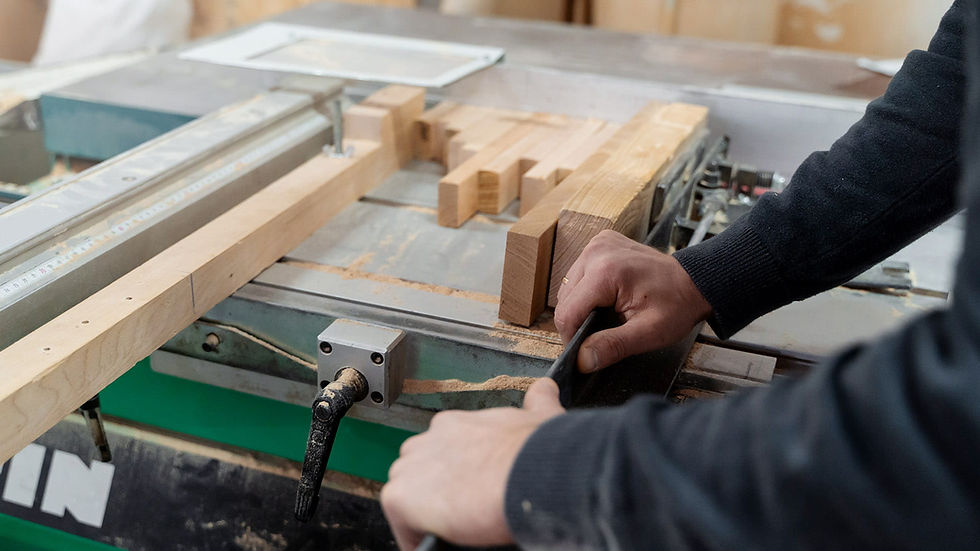
This question separates workshop-based contractors from on-site assemblers. Custom carpentry in KL produced in a controlled workshop on CNC machinery is cut to tighter tolerances than work assembled on-site. The difference shows in how cleanly doors align and how consistently the finish holds across multiple pieces.
Ask where the panels are cut, where the finish is applied, and whether the team that builds the cabinets also installs them. A contractor who sources panels from a third party and assembles on-site can only warrant the labour. One who fabricates in-house is accountable for both the materials and the build quality. Per Houzz's guide to questions for remodelers, asking who does the actual work and whether it's done in-house or subcontracted is one of the most useful questions to ask before any renovation contract is signed.
4. What Does the Timeline Include?

A timeline on a carpentry quotation KL document should show more than a start and end date. It should indicate when the site measurement happens, when design approval is expected, when fabrication begins, and when installation is scheduled. These are sequential stages, and delays in earlier stages push every subsequent stage back.
Ask whether the fabrication runs in parallel with other renovation trades or whether it begins after site works are complete. A workshop-based contractor who starts fabricating after the design is approved can run production while plastering and tiling are still underway. That parallel workflow shortens the overall renovation timeline by two to four weeks compared to a contractor who can only begin once the site is ready. Find out also whether the timeline in the quote is a fixed commitment or an estimate subject to change.
5. Is the 3D Design Included?

A 3D design proposal allows the homeowner to see how the cabinetry will sit in the room before anything is built. This step closes the gap between what the homeowner imagined and what the contractor understood. Without it, changes after fabrication begins are expensive and time-consuming.
Some custom carpentry KL contractors include 3D design as part of the consultation process. Dohson, for example, provides free 2D space planning and a 3D concept (worth RM1,200) with every project. Ask whether 3D visualisation is included in the quote or charged separately, and whether the homeowner has full approval rights over the design before fabrication begins. A contractor who starts cutting before the design is signed off is a contractor setting up a dispute.
6. What Finish Is Specified and Where?

Cabinet finishes in Malaysia include laminate, spray paint (catalysed lacquer or two-pack polyurethane), and membrane wrap for door faces. Each has different performance characteristics, and the right choice depends on which zone of the kitchen or room the cabinet occupies.
A carpentry quotation KL document that specifies "spray paint" without indicating the paint grade or topcoat type leaves room for the contractor to use a lower-quality product than what was discussed. Ask for the finish to be named specifically: "two-pack polyurethane, semi-gloss" or "high-pressure laminate with ABS edge banding." The finish specification should also state whether it applies to all exposed surfaces or only to the door fronts. Cabinet carcasses that are left unfinished inside damp zones deteriorate faster than those with an interior coating.
7. What Hardware Is Included?

Hardware means hinges, drawer runners, handles, soft-close mechanisms, and any internal fittings like pull-out carousels or drawer organisers. Hardware quality determines how the cabinet functions every day, and low-quality hardware fails faster than the cabinet itself.
Budget hinges lose tension within two to three years and cause doors to sag or misalign. Drawer runners that use steel ball bearings rather than nylon glides carry more weight and last longer. Ask what brand and grade of hardware are specified in the quote. Blum, Hettich, and Grass are established hardware brands used by professional workshop operations. A quote that says "soft-close hardware included" without naming the brand is giving the contractor discretion to use whatever is cheapest.
Ask your custom cabinet contractor to name the hardware brand before you sign. It takes 30 seconds to ask and can save years of door adjustments.
8. What Does the Warranty Cover and for How Long?

A warranty on custom carpentry in KL should cover both the materials and the workmanship, not just one or the other. A contractor who manufactures and installs their own work can warrant both. A contractor who sources panels from a supplier and installs them on-site can typically only warrant the labour, because they don't control the material quality.
Ask specifically: what does the warranty cover, how long does it last, and what is the process for raising a defect after installation? A one-year workmanship warranty is common. Some workshop-based contractors extend this to two or three years for clients who used quality board specifications. The warranty period is less important than what it actually covers and how responsive the contractor is when you need to use it.
9. Is the Quote Fixed or Subject to Variation?

This is the question most homeowners forget to ask, and it's the one most likely to affect the final bill. A fixed-price quote means the contractor is committing to the stated price for the stated scope. A quote described as an "estimate" or "indicative price" can change as the project progresses.
Variations are legitimate when the scope changes, such as when the homeowner adds items or changes materials after signing. They become a problem when the original quote was deliberately incomplete, leaving out items the homeowner assumed were included. Ask the contractor to walk through what is and is not included in the quote line by line. Anything not mentioned is a potential variation. Common omissions include: delivery and site protection, touch-up paint after installation, removal of old cabinetry, and electrical integration for in-cabinet lighting.
A detailed quote is a form of contractor accountability. Contractors who resist giving one are telling you something about how they'll handle disputes later.
Should You Ask All 9 Before Signing?
Yes. A contractor who answers all nine questions directly and in writing is one who understands exactly what they're building and is confident in their process. Most contractors working at a professional level will welcome the questions. The ones who don't are the ones most likely to generate problems mid-project.
For a full renovation covering kitchen cabinets, wardrobes, and living room carpentry in Klang Valley, getting this right before signing saves time, money, and stress at every stage that follows.
Frequently Asked Questions
1. What should a carpentry quotation in KL include?
A solid carpentry quotation KL document should include the board type and grade, edge banding specification, finish type and paint grade, hardware brand, fabrication location, installation timeline, payment schedule, and warranty terms. A quote that omits any of these leaves room for assumptions that benefit the contractor rather than the homeowner.
2. How do I compare two carpentry quotes that look similar in price?
Compare them line by line on board type, edge banding grade, hardware brand, and finish specification. Two quotes at similar prices can represent very different material quality. Ask both contractors to confirm their cabinet materials Malaysia specification in writing, and the quality difference will usually become clear immediately.
3. What is a reasonable timeline for a full custom carpentry KL project?
For a full-home cabinet project covering kitchen, wardrobes, and living room carpentry, expect six to ten weeks from design approval to completed installation. The consultation and design phase adds one to two weeks at the start. Contractors who promise significantly shorter timelines without explaining how should be asked where they're compressing the schedule.
4. Can I ask a custom cabinet contractor to revise the quote before I sign?
Yes, and you should. Asking a contractor to revise the quote to include a higher board grade, named hardware, or a specific finish is entirely standard. A contractor who refuses to revise the quote or treats the request as unreasonable is not a contractor who will respond well when problems arise during the build.
5. How do I know if a carpentry contractor is experienced enough for a full renovation?
Ask to see completed projects of similar scope. Check whether they have a showroom or workshop you can visit. Find out how long they've been operating and whether they can provide references. Contractors with 20+ years of experience and an established client base, like the team at Dohson's custom carpentry workshop in Puchong, carry a track record that newer operations can't replicate.
Signing a carpentry quote in KL should feel like a confident decision, not a leap of faith. These nine questions give you a clear framework for evaluating any contractor before any money changes hands. Ask them on a phone call, at the site visit, or in writing before the quote is finalised. The answers will either confirm that you've found the right team or save you from a project that won't deliver what you expected. If you'd like to see how Dohson's team handles each of these questions for a full renovation in Klang Valley, visit the showroom at No. 30, Jalan Puteri 5/1, Bandar Puteri, Puchong, or speak with the team at Dohson's cabinet manufacturing workshop for a consultation and free 3D design concept.


